



|
|
|
POMPEI - CAMPANIA - SOUTH ITALY VISIT & SEE HISTORY THE ERUPTION This hystorical town is made up of 12 hamlets near the foot of Vesuvio that developed in the 11th century around a small cult building. It was a town made famous in the whole world by a tragic event, attracts thousands of tourists every day, lives great traditions, offers delicious local culinary products and amazing town feasts that begin in March and go right through to December. 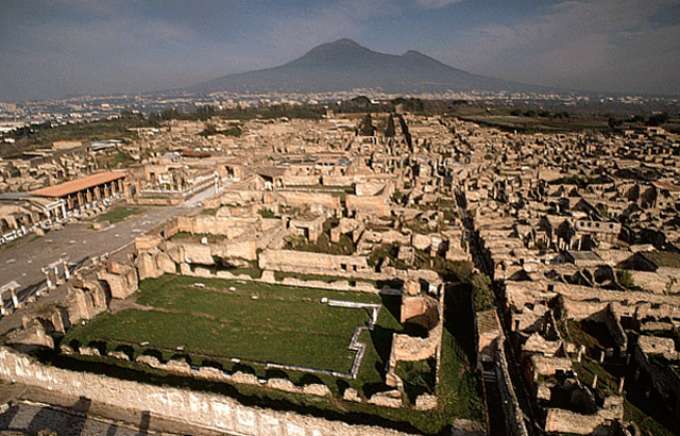
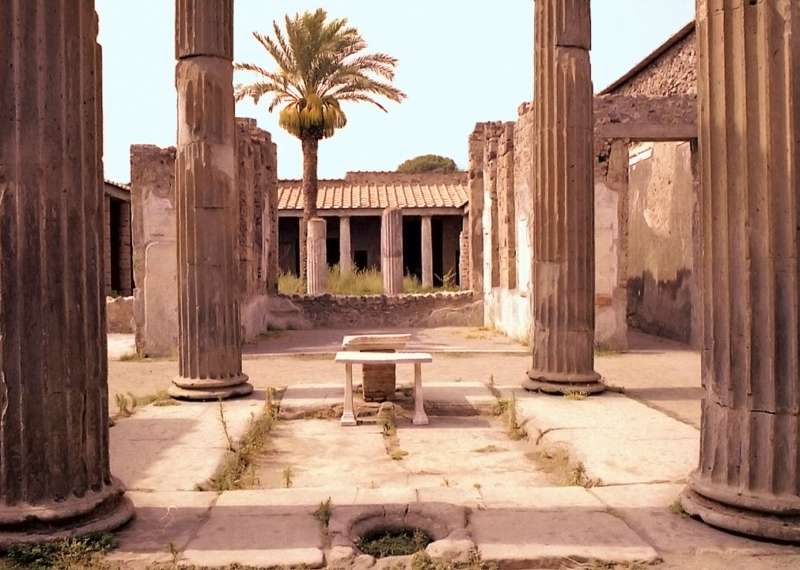
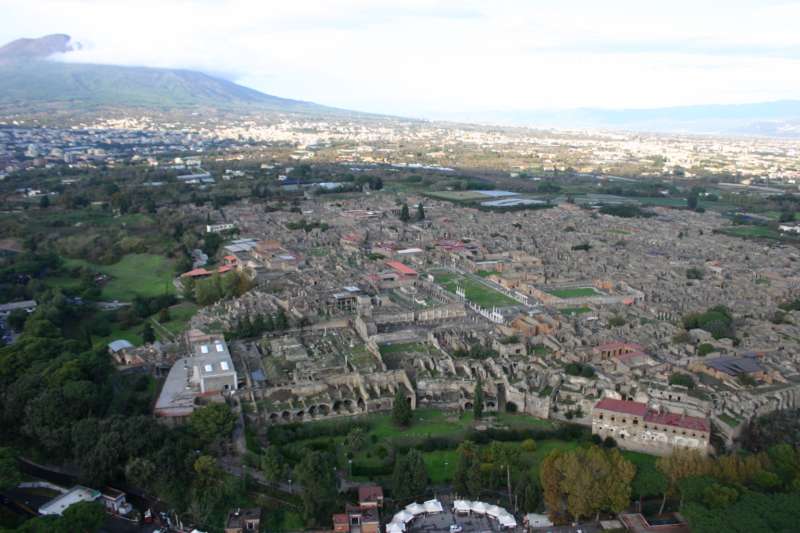
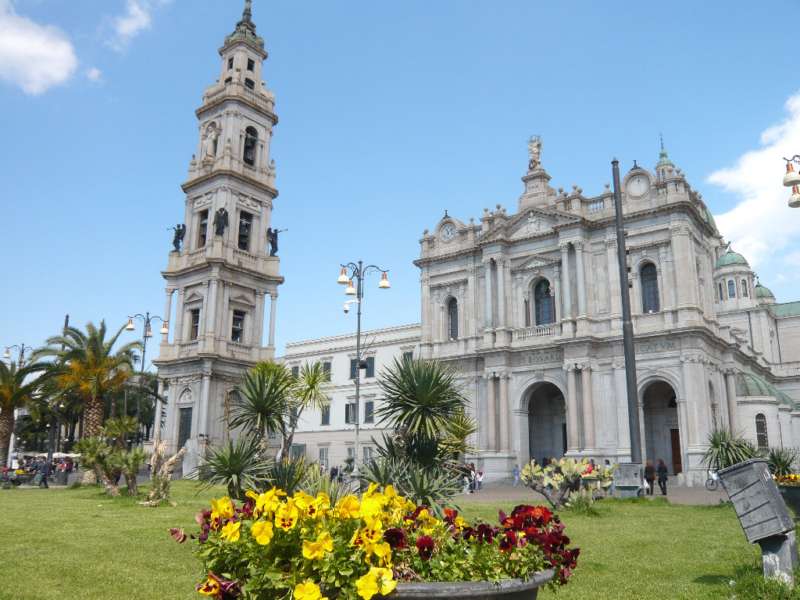
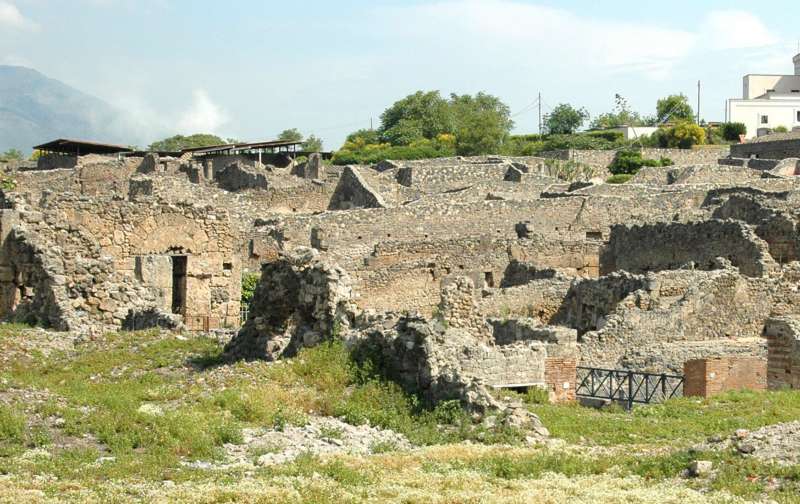
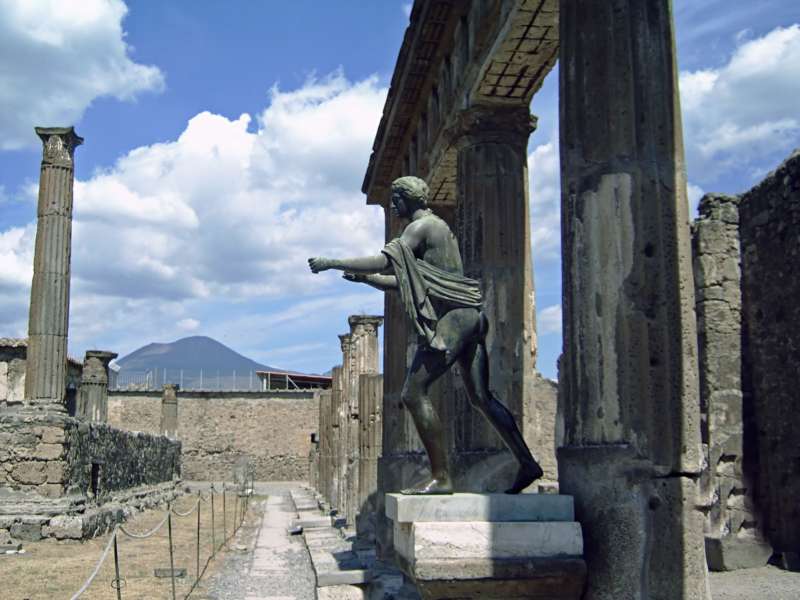
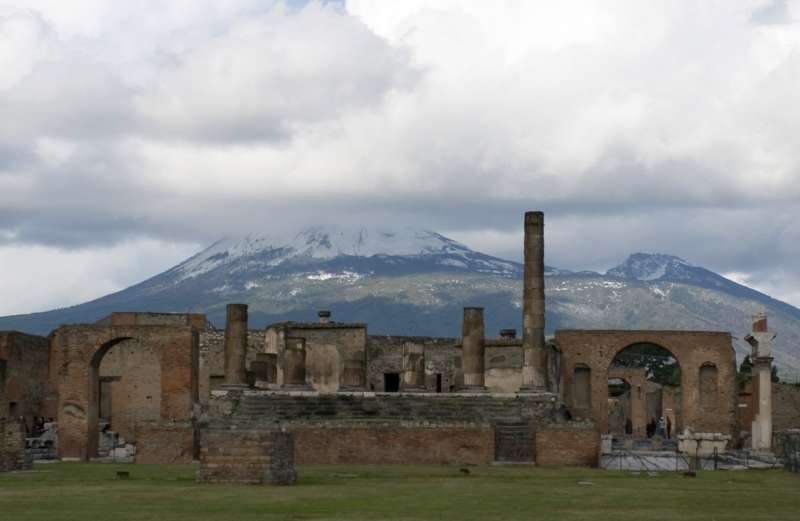
Old Pompei who's first construction dates back to the 7th B.C. was tragically destroyed by a catastrophic eruption of the close by Vesuvius Volcano in 79 A.D. and miraculously unearthed representing a unique historical and human document. The Excavations of Old Pompei whose roads seem to lead back in time to an era unknown to any individual but amazingly presented by this site are the picture, still intact, of a city whose life was unexpectedly interrupted. For centuries, Pompei was a mystery, there was no information referring to this town, even its exact position was unknown. The first discoveries took place in 1628 during pipe works in the Sarno valley. The most extraordinary aspect of pompei is represented by the variety of styles amongst the paintings covering the walls of the houses. Such paintings are almost always pieces copied from the masterworks of celebrated Grecian artists which, unfortunately, are now lost. One quick glance at the lay-out of the city and a fundamental fact immediately catches one's eye: Pompei, unlike Herculaneum and ancient Naples, is not the fruit of an organic design of city planners. In the regular town design two atypical nucleuses stand out: one, roughly quadrilateral, around the "civil forum" and the other around the tiny "triangular forum" next to the theatres district. To those nuclei is linked the rest of the city which by contrast looks "new": all this enclosed within solid city walls. The observation reveal the secret of the origins and development of Pompei who only achieved this name in the 20s thanks to the strong push of the imposing Shrine founded by Beato Bartolo Longo. Its evident that this town had a Mediterranean vocation from the earliest history as it's port is situated on the mouth of the river Sarno, its hinterland came to include in time Acerra, Nola, Nuceria, as the ancient historian Strabo attests. On a bed of prehistoric lava, Pompei is founded in the second half of the VIIth century B.C. and seems to be organized and built as a lookout and for defence probably influenced by the Greeks and the natives. The natives, peaceful when first colonized, later matured notions of armed action when the Chalcidenses, who held defensive posts along the sea-coast, threatened to cut off the people of Campania's access to the sea. Despite the documented existence of a Doric temple dating from the second half of the VIth century B.C. on the terrace of the triangular forum, and other indications that were held valid until only a few years ago, pompei was not a Greek city, even though it had been influenced by Greek culture ever since the most archaic epoch. In the light of the results obtained from the stratigraphic researches carried out in these last years, it appears that Pompei, at the time of its foundation and its first development, was much more conditioned, politically, by the Etruscans than by the Greeks. There is also evidence that it was connected to an "Etruscan territory" centred on Capua (Santa Maria Capua Vetere), which comprised large portions of inland Campania and, through the Sarno valley, the Sorrento peninsula. Findings in Vico Equense has produced disconcerting evidence of this. Pompei's commercial vocation completely upsets the former architectural and decorative order, transforms the habits of its inhabitants, generates self-made entrepreneurs and exploiters. A "vertical section" of the city in the last decades of its life before the 79 A.D. eruption of Vesuvius, would offer a picture - in contrast with the calm of former times - of roads, inns, taverns bustling with people, brothels in full activity, stall keepers in the forum, the amphiteatre cram-full of people, slaves of an irrational passion for sport, always ready for a brawl, walls covered with election slogans in favour of this or that candidate, graffiti with names, quips, love messages everywhere. House building in the meanwhile was capriciously spreading beyond the walls, it consolidated westwards in dismal phalansteries. Painting lost its capacity of perspective. The former articulation which can be seen in the vast cycles of paintings of the "Villa of the Mysteries" (Villa dei Misteri), is often reduced to nothing but commonplace and poor quality decoration. In the last few years every possible effort has been concentrated on restoration but excavations have also been going on the city walls, bringing to light the walls from "Porta di Sarno" to "Porta di Nola" and beyond towards "Porta Vesuvius". The four-storey building that incorporates the walls, north of "Porta Marina", has been excavated while the diggings at the "House of Julius Polybius" (Casa di Giulio Polibio) have brought to light new and sensational discoveries. The zones that still have to be excavated in the north-eastern area may hold some more unexpected surprises in store but at this point we can say that the "picture" of life in pompei, has already been quite clearly defined. The pompei excavations are a whole turistic site to be visited and seen: a whole town that was previously destroyed and then miraculously rediscovered. The first archaeological explorations took place towards the mid-18th century, and excavations soon began in earnest, but not until 1860 were they conducted in an orderly, systematic way. It is thought that, to date, about three-fifths of the ancient town has been excavated. pompei is one of the most important archaeological sites in the world, because it provides a complete picture of the topography and life of town of that age with those influences. There are two theatres: the Odeon, built between 80-75 B.C., used for musical recitals and mime-shows, and the Large Theatre, with seating for 5,000 spectators, which dates from the Hellenistic period (200-150 B.C.). The largest baths were the Stabian Baths, built in the Samnite period and reconstructed in the Imperial period. The stucco decoration, dating from the Flavian period, is some of the finest surviving. The many houses of remarkable beauty include the House of the Vettii, one of the most interesting examples of a rich merchant's house, while the Villa of Mysteries is perhaps the most important building in the whole of Pompei. Its most interesting feature is a cycle of paintings dating from the 1st century B.C. which decorate the walls of one of the rooms in the centre of the house. Many other buildings are worth special attention like the House of Menander, the House of Loreius Tiburtinus, the House of the Golden Cherubs, the House of the Faun, the Villa of Diomedes and the Amphitheatre. Also Visit:
Those last days of August had been preceded by earth tremors, a common enough phenomenon in Campania that aroused no particular apprehension. But early in the afternoon of the 24th an enormous cloud in the shape of a pine tree appeared that continuously changed colour. The admiral was studying the cloud, not knowing its cause, when a call for help arrived from Rectina, the wife of Tascio, who lived at the foot of Vesuvius. She found herself hemmed in by the eruption, with only the sea offering a possible route to safety. The admiral ordered the entire fleet to put to sea, intending to take off as many as possible of the numerous inhabitants along that part of the coast. During the crossing the ships were covered in the ash pouring out of the volcano, which as they drew nearer the coast became hotter and denser, containing flaming pumicite and lapilli. The force of the eruption was such that the ships could not land and had to sail on the port of Stabiae, four miles to the south of Pompei. The admiral went ashore and had dinner as guest of Pomponiano, continuing to scrutinising the spectacle that, with nightfall, had become truly awesome. There was no let up in the shower of ash, which built up in drifts in the central courtyard of the house, forcing the diners to leave the dining room before they were trapped inside. What is more, the tremors went on unabated, shaking the buildings to their foundations, and everybody chose to stay out in the open, covering their heads with cushions to protect themselves from the storm of scorching particles, rather than risk being buried under falling masonry. At dawn on August 25th the light of the sun was unable to penetrate the thick veil of soot hanging over the never-ending eruption, while the condition of wind and sea continued to make escape impossible. The admiral was overcome by the choking ashes mixed with sulphurous exhalations and he died along with many other inhabitants of pompei. The contorted corpses of some of them have been restored to us in plaster casts, bringing home the excruciating suffering of a death by suffocation from fumes. During the years the city passed into total oblivion, such that even its name was forgotten. Even in the first years of excavations, which began in 1748, no one was quite sure whether the site was Stabiae or pompei, until, as Winckelmann recorded, an inscription came to light which proclaimed unequivocally the name of the pompeian colony. Since then more than two centuries have gone by, and millions of visitors have come to experience one of the most significant legacies of the ancient world. |
||||||||