



|
|
|
CAPRI ISLAND - CAMPANIA - SOUTH ITALY
HOTEL ROOMS ACCOMMODATIONS OFFERS IN CAPRI ISLAND
WHERE TO EAT WHERE TO HAVE FUN EXCURSIONS SPONSORS VISIT & SEE THE FARAGLIONI HISTORY The Island of Capri and the Amalfi Coast are some of the most important visiting tourist resorts of the South Italy, attracting many visitors every year from worldwide nations like United States, Japan & Europe. 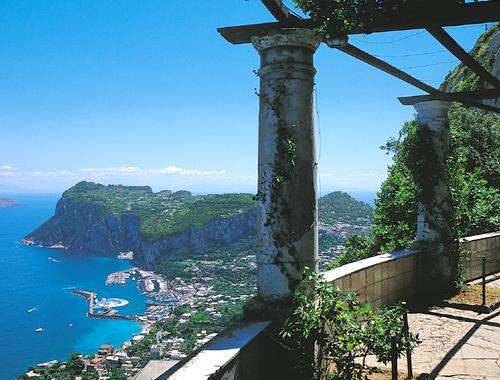
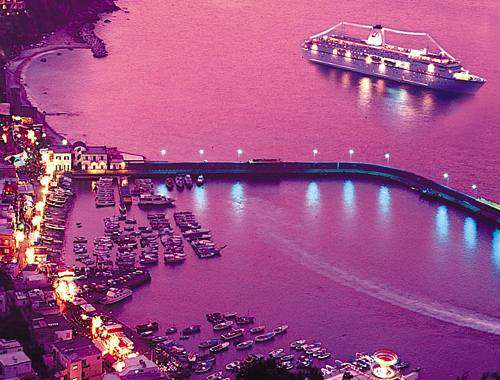
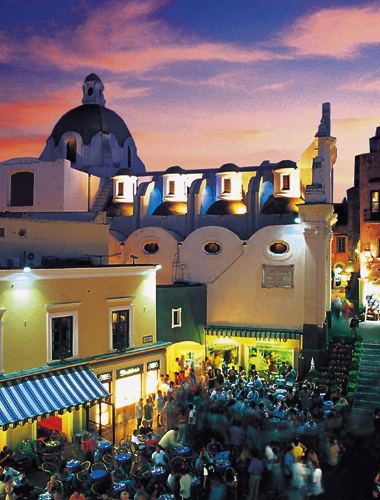
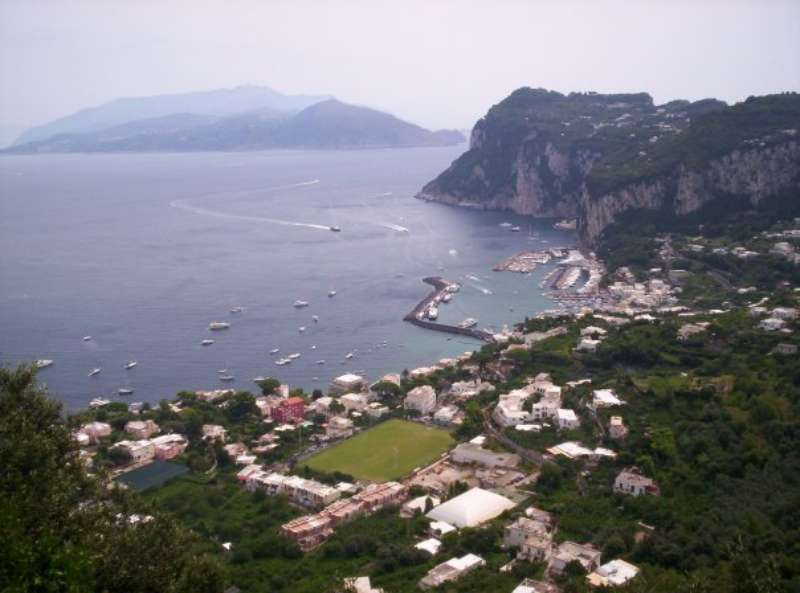
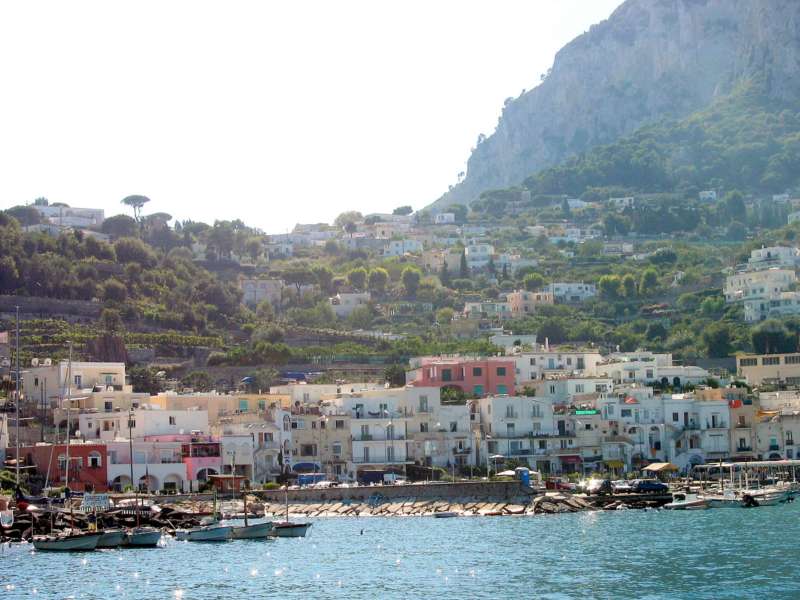
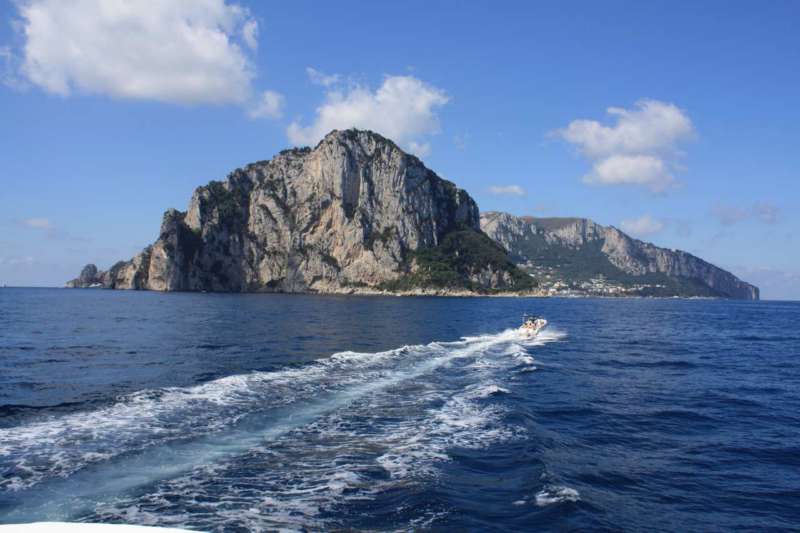
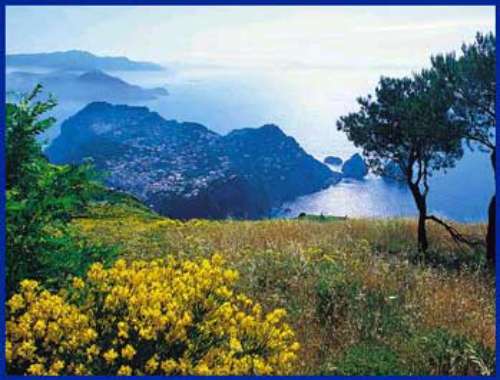
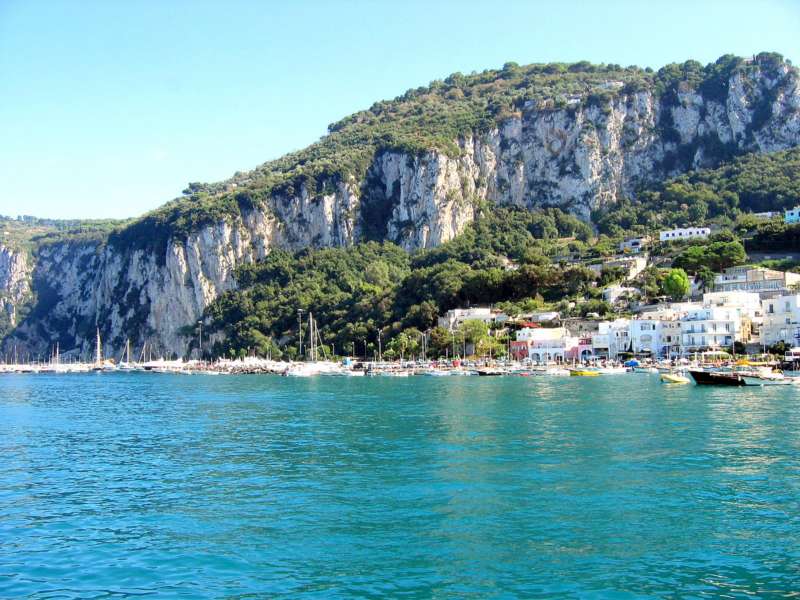
The beautiful Isle of Capri, is located just off the Amalfi Coast at the mouth of the Gulf of Naples facing the breath of the Tyrrhenian Sea and boasting natural beauties that bewitch any visitor even of the highest prestige. Its innumerable sea caverns, rugged terrain of terraces and precipices, the unspoilt beauty of Monte Solaro, all enhance the enchantment that this Isle has upon everybody who visits it. Capri, is the Isle's main town and is located in a commanding location above the two "Marinas". With its characteristic arcades that merge into a labyrinth of narrow alleys and streets, and the sea that can be heard, seen and even it's perfume is perceptible from every part of this island, Capri works its own special charm on every visitor and allows an unofficial rendezvous for a colourful congregation of guests from all over the world, who can admire the most breathtaking view that covers from Ischia to the peninsula of Sorrento. Charming local towns and extraordinary hospitality open the island's beauty to many visitors from all over the world and it was the world's most famous writers who stayed in Capri and who, enchanted by it's charm, favoured it's rediscovery and popularity with international tourism. Capri in fact has been sought out by numerous writers and scholars. Of the many men of letters from various countries who came to this Tyrrhenian island in search of inspiration for their great works of literature the Swedish physician Axel Munthe deserves special mention; needless to say, many other famous names from world literature can also be found here. A town neighbour of Capri and captivating vacation resort is Anacapri, surrounded by Mediterranean country side of exceptional beauty it is set at the feet of Monte Solaro, an unforgettable lookout point, that can only be reached from this town with a chairlift or by foot trail. In early days these two towns were not connected by any road but only by a stair case "Scala Fenicia" that climbs steeply to the "Castello di Barbarossa" castle. Nowadays the simple road network that runs along the main axis between Capri and Anacapri has few side roads and can only be travelled by local residents; the island has just been declared a pedestrian zone, especially as a means of protecting the countryside. This town also features the most famous "Piazzetta", small town square, that is the built-up area of Capri and is the tourist and fashionable meeting point completely closed that looks like a courtyard; it is surrounded by the public buildings placed in the former bishop's palace, by shops and cafes and by the Torre dell' Orologio, that probably was the bell tower of the old cathedral. It's background is the picturesque left side of St. Stephen church. The square had to belong to the old inhabited centre of Capri (5th- 4th century b.C.) as witnessed by some limestone pieces of walls in a square or pseudo-polygonal shape, which are visible from the end of the terrace of the cable railway and incorporated among medieval houses and walls, on the northern-eastern side of the built-up area. Together with another wall tract at the foot of Castiglione and with some Roman ruins, they formed the imposing fortified wall of the Greek acropolis. The medieval suburb dominates around the square, it is very interesting from the historic-urban point of view and it is characterised by narrow and tortuous alleys. Almost all the space is taken up by the tables of the numerous cafes, bars and "ice cream houses, producing the feeling of a big, open air, wonderful drawing room. This Island once had no natural ports and was only accessible by a small beach, but in time the two Marina Ports were built, the "Marina Grande" and the "Marina Piccola". The first one was firstly built on the western coast with Roman Origins, today lies more towards the east and docks the daily ferry boats and hydrofoils coming from other resorts as well as yachts and most beautiful sailing boats especially during summer months. The second port instead originated as a group of coral fisherman's houses dominating two small beaches made of gravel near an old docking bay with Roman origins. Since the '30s it developed thanks to the attention it drew by sea tourism. The "Parrocchiale di Santo Stefano" (Parish Church of St. Stephan) was built in the 17th century on the ruins of an earlier cathedral and is most amusing for all it's visitors. Here you can find works of the Baroque Style Art, a great example of this is the multicoloured marble floor in the Villa Jovis. On a rise not far from Capri is "Santa Maria del Soccorso" with its beautiful panorama of the Sorrento Peninsula and the ruins of Villa Jovis. This typical example of Roman villas is commonly known as the "Palazzo di Tiberio". Legend has it that Tiberius himself ruled the Roman Empire from this villa, and the entire area abounds with sagas and legends about the Roman Emperor. The "Salto di Tiberio" occupies a special place in the legends as a steep precipice, off which the Emperor's enemies were pushed. A short distance from Villa Jovis are the ruins of an old lighthouse, the Torre del Faro. The part of Capri known as Marina Grande is the island's most important harbour, fully equipped whit modern port facilities. Moreover, Marina Grande is a famous swimming and sunning resort. The cog railway makes the trip to Capri in four minutes. There is also a well paved road to Capri, along which are the "Chiesa di San Costanzo" dating back to the 11th century and the "Scala Fenicia" that steeply climbs up to the "Castello di Barbarossa" castle. Also Visit:
An Itinerary to see and admire some of the wonderful characters of this Isle could be:
A boat trip around the island, especially in the summer season, can be a very enjoyable experience, showing Capri from a completely different point if view and providing rare views of the breathtaking beauty that makes Capri so famous.
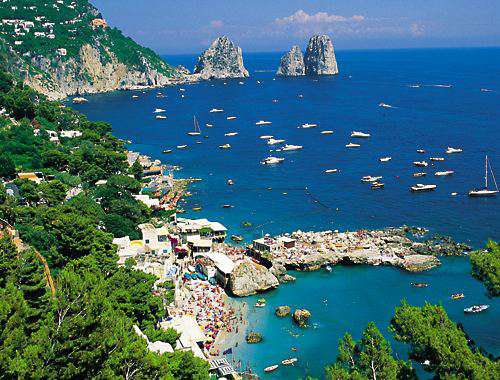
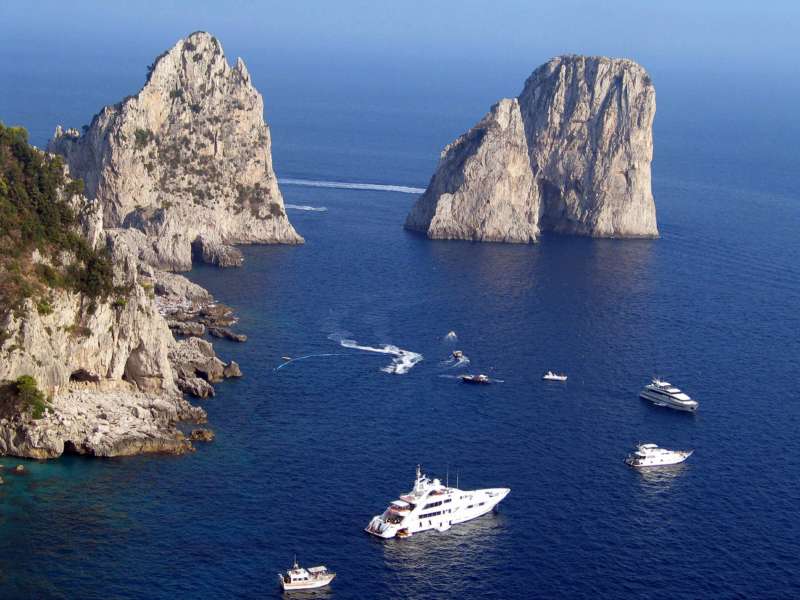
The FaraglioniThe Faraglioni are certainly Capri's best renowned feature all around the world.
These sea rocks are also famous for hosting a rare variety of lizard, the "Blue lizard" ("lacerta coerulea muralis" or "faraglionensis"), called like this for the peculiar bluish colour all over its body. This lizard was once thought only to live on Capri's Faraglioni, although nowadays they also seem to be present on similar rocks along Sicily's Coast.
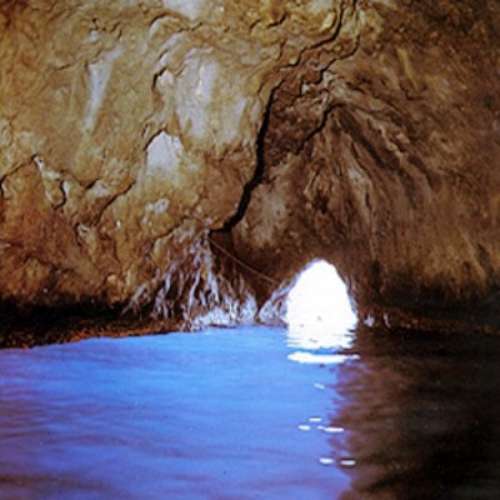
"Villa Malaparte" situated on The Massullo Point, territory of Capri near the Faraglioni, is a notorious building originally owned by Curt Suckert, a writer and journalist known locally as Curzio Malaparte who, during a visit to Capri in 1936, bought this land near the Faraglioni rocks from the Vuotto family to build a summer home.Despite local opposition Malaparte completed his project between 1938 and 1939. Designed by the architect Adalberto Libera and worked on by Amitrano with contributions from Malaparte himself, this now famous work is integrated with the landscape, its outline rests on the rock. This Villa is known to have accommodated famous people like Moravia, Togliatti, Jean Cocteau and Albert Camus. Upon Malaparte's death it was donated to the People's Republic of China. It later became the centre for a cultural foundation and on occasion is used for conferences and art exhibitions. Of all the islands of the Parthenopean Gulf, Capri is the only one not of volcanic origin in this almost exclusively volcanic area. Capri has been settled since the Late Stone Age, as archaeological excavations at the beginning of this century have confirmed. At the time the Phlegrean volcanoes were at their most active state, Capri and the Sorrento Peninsula in fact formed a solid block that gradually broke apart under the pressure of the organic forces during the ensuing geological periods, leaving Capri as Island. Soaring up from the depths of the sea, Capri's limestone composition is revealed in the island's slopes and its steep but unusually lovely dolomite walls, not to mention its numerous natural grottoes , together with the cliffs in the southeast, have made the Isle of Capri world famous. Capri's elevation above sea level is very unstable, as you can tell from the slow but unrelenting fluctuation in the island's shoreline. In the course of many centuries this fluctuation caused a drop in the water level in the famous "Grotta Azzurra" (Blue Grotto) and the "Bagni di Tiberio" (Tiberius' Baths). This is proved, beyond no doubt, by architectural findings from the Roman times in both places. The origin of the name "Capri" is a hotly disputed subject: while Strabo called the island Caprea or Island of the Coarse Stones, Varro named the island Capreae after its odd profile and its characteristic fauna, predominately wild goats. Other theories contend that this name is not correct and regard "Capros" (wild boar) as the origin of the present "Capri". At any rate, it is certain that the island was a Greek colony, even though it is hard to pinpoint the exact date it was colonized. In 29 BC Caesar Augustus visited the island, that he bought from the Neapolitans in exchange of Capri's neighbour the "Isle of Ischia". The island attained its greatest glory under Caesar Augustus' successor, Tiberius, lived on Capri about 26 b.C, where he ruled the Roman Empire from, for the last ten years of his reign. His stay on the island is reflected in numerous names that still appear on today's maps. Ruins of at least three of the twelve villas built by Tiberius are still visible, whilst all traces of the other nine have been lost. Originally erected in twelve to honour the twelve main Roman Gods, traces of the long lost nine buildings mite still be found as they could very well be hidden in camouflage and difficult to recognize among the great abundance of Roman ruins that cover this Island. The most famous of the three remaining villas erected by the Roman Emperor, whom legend has sheathed in mystery and ruthless violence, undoubtedly is the "Villa Jovis" (Jupiter's Villa), which commands a view of the entire Gulf of Naples from its location a top the Capo. It is said to have been the residence of the Emperor Tiberius himself. The remains of another villa are located in "Damecuta", while other findings dating back to the Imperial Rome can still be found near "Case Palazzo a Mare", the site of the "Bagni di Tiberio" (Tiberius' Baths). After Tiberius' death the island fell into inexorable decline, shared with the fate of Naples and the most important ruling families. It was attacked by barbarians and pirates, and was repeatedly struck by earthquakes that played a major part in wiping out the traces of the island's ancient heritage. The Lombards and Normans alternately took possession of the island, only to be followed by Aragon and Anjou succession, until it finally came under Spanish control, who dominated the entire Neapolitan area for a considerable period of time. In the 17th century, the island's residents succumbed to the plague. Thereafter, the Bourbons took over the island, followed by struggles between the English and the French over Capri's strategic location. Prior to the unification of Italy, Capri belonged to Naples. From the beginning of the previous century until today. You may consider staying in the area between Maratea and Diamante central to the whole of the South Italy, so please check the availability below and book a Hotel accommodation by the sea or in the beutiful rural area and center point for other major South Italy destinations within a few hours of relaxing, discovering car drive. Distances to Capri approx. Check Hotel Accommodation availability and book in these towns:
|
||||||||||||||||||||